Showing posts with label proof. Show all posts

Saturday, 18 July 2015

Ratio of the areas of the circumcircle and the incircle of an n-sided regular polygon

Question:

To find the ratio of the areas of the circumcircle and the incircle of an n-sided regular polygon.

Solution:


Result:

The ratio of the areas of the circumcircle and the incircle of an n sided regular polygon is square of the secant ratio of (pi divided by the number of sides of the regular ploygon).

Note:

The ratio of the areas of the circumcircle and the incircle of an n-sided regular polygon is independent of size of the side. It depends only on the number of sides.

© Rishabh Bidya

Sunday, 5 July 2015

Difference between the areas of the circumcircle and the incircle of an n-sided regular polygon

Question:

To find the difference between the areas of the circumcircle and the incircle of an n-sided regular polygon.

Solution:


Result:

The difference between the areas of the circumcircle and the incircle of an n sided regular polygon is pi times square of the length of the side divided by 4.

Note:

The difference between the areas of the circumcircle and the incircle of an n-sided regular polygon is independent of the number of sides. It depends only on the length of the side.
© Rishabh Bidya

Sunday, 26 April 2015

Pattern in sixth powers of numbers : Last two digits of sixth powers of numbers at a difference of 10

The procedure:
Take any number (Say x).
Form a set of numbers by adding 10 (Your set={x,x+10,x+20,x+30,...}).
Raise every member of the obtained set to its sixth power.
Observe the last two digits (taken from right to left) of the obtained sixth powers.
The last two digits of the sixth powers repeat after every five members of the set.


(Note the numbers highlighted in yellow repeating in the same column)

The Proof:
Any 6 terms of the series will be of the format x,x+10,x+20,x+30,x+40,x+50.
We need to prove that the pattern of the sixth powers repeats after every 5 terms.
Therefore, it suffices to prove that the digits at the unit place and tens place of sixth power of a number are equal when the number after five terms is raised to the sixth power.
Therefore, we need to prove that the last two digits of the sixth power of x and the sixth power of x+50 are equal. (Since the numbers are taken at a difference of 10 and there are 5 such terms.)


Similarly, last two digits of sixth powers of x+10 and x+60 will be equal.
Similarly, last two digits of sixth powers of x+20 and x+70 will be equal.
And so on ...
Thus, the pattern continues to repeat after every five terms.

Derived Corollary:
The last two digits of a number's sixth power and another number's sixth power are the same when another number is formed by adding a multiple of 50 to the first number.

Important Observation:
If any number has 5 at its unit place, its sixth power ends with 2 and 5 at ten's and unit's place respectively. (This, too can be proved easily).
A similar pattern is observed in the squares, cubes, fourth powers and fifth powers of numbers.

Q.E.D

© Rishabh Bidya

Friday, 20 February 2015

Pattern in fifth powers of numbers : Last two digits of fifth powers of numbers at a difference of 20

The procedure:
Take any number (Say x).
Form a set of numbers by adding 20 (Your set={x,x+20,x+40,x+60,...}).
Raise every member of the obtained set to its fifth power.
Observe the last two digits (taken from right to left) of the obtained fifth powers.
The last two digits of the fifth powers of every member of the set are the same.


The Proof:
Any term of the series will be of the format x+20k(where k must be a non negative integer).
We need to prove that the digits at the unit's and tens's place of the fifth powers of x and x+20k are same.


Example:
We choose 3 as our x.
The set of numbers obtained is {3,23,43,64,...}.
We raise the terms of this set to their fifth powers {243,6436343,147008443,992436543,...}.
We observe the last two digits of the obtained fifth powers.
The number at unit's place is 3 whereas the number at the tens' place is 4.

Derived Corollary:
The last two digits of an odd number's fifth power and another number's fifth power are the same when another number is formed by adding a multiple of 20 to the first number.

Q.E.D

© Rishabh Bidya

Friday, 26 December 2014

Pattern in fourth powers of numbers : Last two digits of fourth powers of numbers at a difference of 10

The procedure:
Take any number (Say x).
Form a set of numbers by adding 10 (Your set={x,x+10,x+20,x+30,...}).
Raise every member of the obtained set to its fourth power.
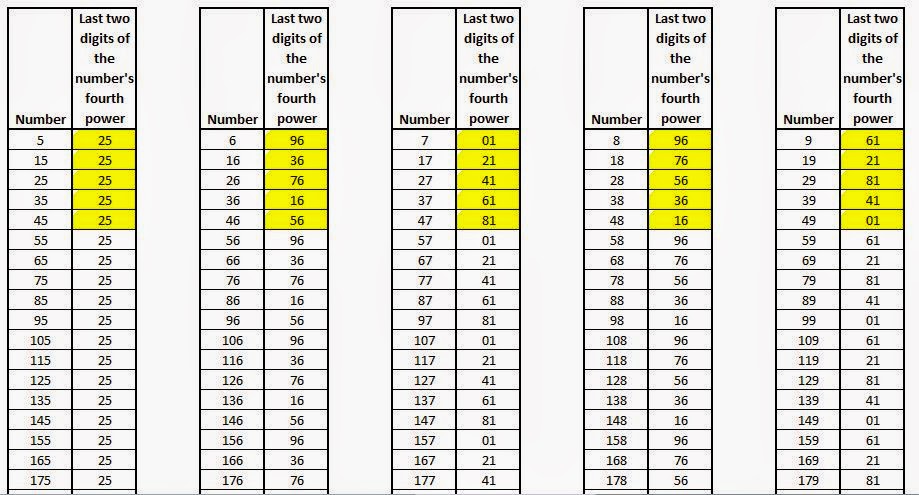
Observe the last two digits (taken from right to left) of the obtained fourth powers.
The last two digits of the fourth powers repeat after every five members of the set.


The Proof:
Any 6 terms of the series will be of the format x,x+10,x+20,x+30,x+40,x+50.
We need to prove that the pattern of the fourth powers repeats after every 5 terms.
Therefore, it suffices to prove that the digits at the unit place and tens place of fourth power of a number are equal when the number after five terms is raised to the fourth power.
Therefore, we need to prove that the last two digits of the fourth power of x and the fourth power of x+50 are equal. (Since the numbers are taken at a difference of 10 and there are 5 such terms.)


Similarly, last two digits of fourth powers of x+10 and x+60 will be equal.
Similarly, last two digits of fourth powers of x+20 and x+70 will be equal.
And so on ...
Thus, the pattern continues to repeat after every five terms.

Example:
We choose 4 as our number.
The set of numbers obtained is {4,14,24,34,44,54,64,74,84,94,104,114,...}.
We raise the terms of this set to their fourth powers {256,38416,331776,1336336,3748096,8503056,16777216,29986576,49787136,78074896,116985856,168896016...}.
We observe the last two digits of the obtained fourth powers {56,16,76,36,96,56,16,76,36,96,56,16...}.
The pattern {56,16,76,36,96} repeats itself.

Derived Corollary:
The last two digits of a number's fourth power and another number's fourth power are the same when another number is formed by adding a multiple of 50 to the first number.

Example of the corollary:
We choose 6 as our first number.
We add multiples of 50 to 6. {6,56,156}
We raise these numbers to their fourth powers. {1296,9834496,592240896}
The last two digits of the numbers obtained are the same, i.e. 9 and 6.

Important Observation:
If any number has 5 at its unit place, its fourth power ends with 2 and 5 at ten's and unit's place respectively. (This, too can be proved easily)
A similar pattern is observed in the cubes of even numbers and in the squares of numbers  .

Q.E.D

© Rishabh Bidya

Thursday, 18 December 2014

Pattern in squares of numbers : Last two digits of squares of numbers at a difference of 10

The procedure:
Take any number (Say x).
Form a set of numbers by adding 10 (Your set={x,x+10,x+20,x+30,...}).
Square every member of your obtained set.
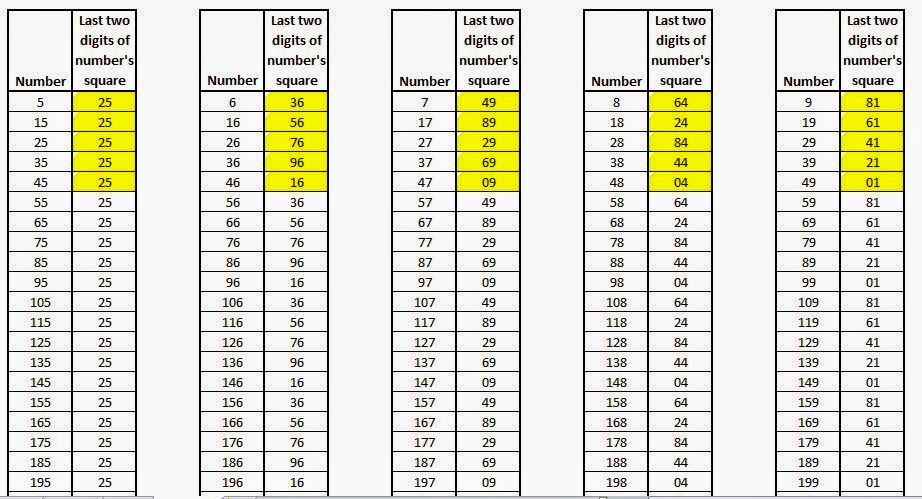
Observe the last two digits (taken from right to left) of the obtained squares.
The last two digits of the squares repeat after every five members of the set.


The Proof: 
Any 6 terms of the series will be of the format x,x+10,x+20,x+30,x+40,x+50.
We need to prove that the last two digits of the square of x and the square of x+50 are equal.


Similarly, last two digits of squares of x+10 and x+60 will be equal.
Similarly, last two digits of squares of x+20 and x+70 will be equal.
And so on ...
Thus, the pattern continues to repeat after every five terms.

Example:
We choose 4 as our number.
The set of numbers obtained is {4,14,24,34,44,54,64,74,84,94,104,114,...}.
We square the members of the obtained set {16,196,576,1156,1936,2916,4096,5476,7056,8836,10816,12996,...}.
We observe the last two digits of the obtained squares {16,96,76,56,36,16,96,76,56,36,16,96,...}.
The pattern {16,96,76,56,36} repeats itself.

Derived Corollary:
The last two digits of a number's square and another number's square are the same when another number is formed by adding a multiple of 50 to the first number. 

Example of the corollary:
We choose 6 as our first number.
We add multiples of 50 to 6. {6,56,156,306}
We square these numbers. {36,3136,24336,93636}
The last two digits of the numbers obtained are the same, i.e. 3 and 6.

Important Observation: 
If any number has 5 at its unit place, it ends with 2 and 5 at ten's and unit's place respectively. (This, too can be proved easily)
A similar pattern is observed in the cubes of even numbers. Pattern in cubes of even numbers at a difference of 10

Q.E.D

© Rishabh Bidya

Friday, 28 November 2014

Pattern in cubes of even numbers : Last two digits of cubes of even numbers at a difference of 10

The procedure:
Take any even number (Say 2x).
Form a set of even numbers by adding 10 (Your set={2x,2x+10,2x+20,2x+30,...}).
Cube every member of your obtained set.
Observe the last two digits (taken from right to left) of the obtained cubes.
The last two digits of the cubes repeat after every five members of the set.


The Proof:
Any 6 terms of the series will be of the format 2x,2x+10,2x+20,2x+30,2x+40,2x+50.
We need to prove that the last two digits of the cube of 2x and the cube of 2x+50 are equal.


Similarly, last two digits of cubes of 2x+10 and 2x+60 will be equal.
Similarly, last two digits of cubes of 2x+20 and 2x+70 will be equal.
And so on ...
Thus, the pattern continues to repeat after every five terms.

Note:
In the first image above, we didn't consider numbers ending with zero, because the cubes of such numbers anyways end with 00. So, such numbers, too can be terms of such a set of numbers.

Example:
We choose 4 as our even number.
The set of even numbers obtained is {4,14,24,34,44,54,64,74,84,94,104,114,...}.
We cube the members of the obtained set {64,2744,13824,39304,85184,157464,262144,405224,592704,830584,1124864,1481544,...}.
We observe the last two digits of the obtained cubes {64,44,24,04,84,64,44,24,04,84,64,44,...}.
The pattern {64,44,24,04,84} repeats itself.

Derived Corollary:
The last two digits of an even number's cube and another number's cube are the same when another number is formed by adding a multiple of 50 to the first number.

Example of the corollary:
We choose 6 as our first number.
We add multiples of 50 to 6. {6,56,156,306}
We cube these numbers. {216,175616,3796416,28652616}
The last two digits of the numbers obtained are the same, i.e. 1 and 6.

Q.E.D

© Rishabh Bidya